" transform="translate(8 10)" width="8px"/></svg>)


Short on time? Here's the 30-second summary:
LMS and LXP solve different employee training problems.
LMS manages courses, assignments, records, and completion.
LXP creates a more personalized employee learning experience.
For customer-facing teams, LMS can make training easier to track, while LXP can make the learning experience more accessible and personalized.
LXP vs LMS compares two models of workplace learning. An LMS, or learning management system, helps companies assign, deliver, and track formal training. An LXP, or learning experience platform, helps employees discover relevant learning through personalization, recommendations, and social learning. The practical difference is simple: LMS starts with the organization’s need to manage training, while LXP starts with the employee’s need to learn in a useful way.
This distinction matters for L&D, HR, hospitality, restaurants, retail, and service operations environments. LinkedIn’s 2025 Workplace Learning Report says 49% of learning and talent development professionals report executive concern that employees lack the right skills to execute business strategy. Source: LinkedIn Workplace Learning Report 2025
A platform that only tracks training may be limited for some development needs. However, a system focused only on experience may not fully meet a company’s reporting, compliance, and standardization needs. This is why platform choice should depend on the purpose of training.
What is an LXP in employee training?
An LXP is a learning experience platform that organizes learning around the employee. It usually combines curated content, role based recommendations, search, social learning, and personalized learning paths.
A learning experience platform helps employees find the right content at the right time. This makes it useful for teams that need skill growth, practical reinforcement, and easier access during work.
What is an LMS in employee training?
An LMS is a learning management system that helps organizations manage training processes from one central platform. It is used for course assignments, completion tracking, certification, compliance training, and reporting. This structure gives companies a more organized and trackable training infrastructure, especially when certain courses must be completed.
What is the difference between LMS and LXP?
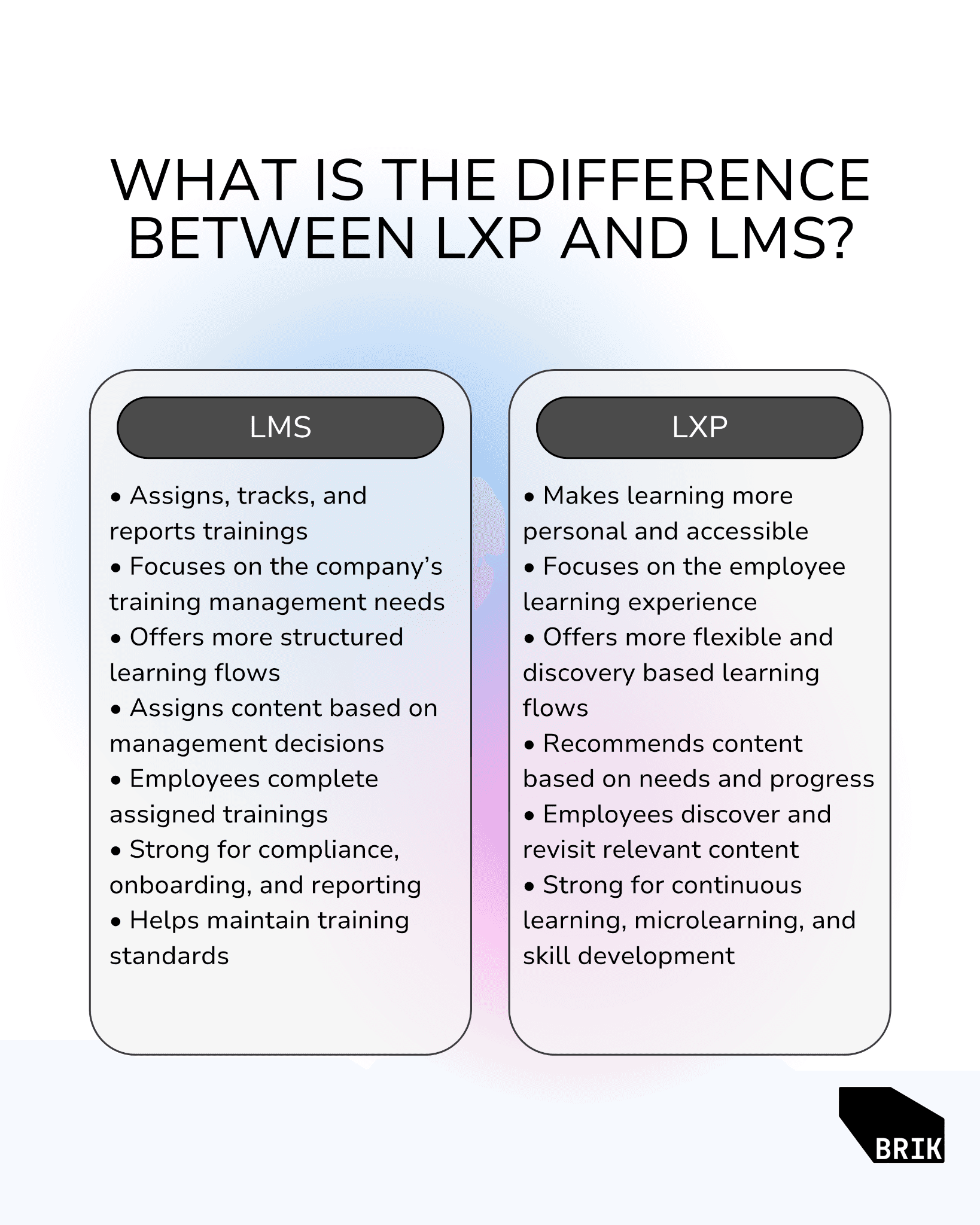
A learning management system focuses on administration, while a learning experience platform focuses on engagement. iSpring’s 2026 comparison explains that an LMS supports structured formal courses, while an LXP emphasizes personalized and self directed learning. Source: iSpring LMS vs LXP Guide
The LMS model works well for compliance, onboarding, certificates, and reporting. The LXP model is useful when the goal is learning adoption, content discovery, skill growth, and motivation.
How do LMS and LXP play different roles for service and operations teams?
In service and operations teams, LMS can be used to assign training and track completion. LXP can support employees by helping them access role relevant content more easily and experience learning closer to their daily workflow. These teams often work away from desks, interact directly with customers or guests, and need information that connects to real work.
For hotels, restaurants, retail stores, cafés, and sales teams, training should be both trackable and relevant to daily workflows. LMS can support assignment and completion tracking, while LXP can strengthen the employee experience through short content, multilingual access, and role relevant learning paths.
What questions should you ask when choosing LXP or LMS?
Do you need to track training completion?
Do you have certification, compliance, or required training processes?
Do employees need to discover content on their own?
Should training differ by role?
Are mobile access and short content critical?
Is reporting or learning experience the main priority?
Is LMS still useful when companies adopt LXP?
LMS remains useful for formal training, compliance, and completion data. LXP does not remove the need for structure, especially in complex operations.
The stronger model combines LMS discipline with LXP experience. Companies can keep clear requirements while improving how employees discover and practice. For many organizations, the question is not only “LXP or LMS?” The more important question is how much structure, tracking, flexibility, and employee experience the training model needs.
Key Takeaways
LMS supports training management, reporting, onboarding, and required learning records. LXP supports the employee learning experience through personalization, discovery, and accessibility.
Customer-facing teams need learning that fits real work. Mobile access, microlearning, personalization, and multilingual content make training easier to use.
Employee training becomes more scalable when the platform respects both business needs and the employee’s real working rhythm.
If you’d like to design an employee training approach that fits your team’s needs, you can contact Brik.
FAQ
What does LXP mean?
LXP means learning experience platform. It is a digital learning platform that focuses on personalized, learner centered employee development.
What does LMS mean?
LMS means learning management system. It helps companies assign, track, report, and manage employee training and completion processes.
What is the main difference between LMS and LXP?
The main difference is focus. LMS manages training delivery and tracking, while LXP improves the learning experience through personalization and discovery.
How can my business use an LXP approach?
Your business can use an LXP approach by making employee training more personalized, mobile, and connected to real work. Brik helps customer-facing teams apply this approach through microlearning modules, gamification, multilingual learning, spaced repetition, and practical content that employees can use during work.
Is LXP better than LMS?
LXP and LMS address different needs. LXP is strong in learning experience, personalization, and content discovery. LMS is suitable for compliance training, certificates, assignments, and reporting. Which one works better depends on the organization’s training goals.
How can LMS and LXP be used for customer-facing teams?
For customer-facing teams, LMS can be used to assign training and track completion. LXP can support mobile, short, role relevant, and practical learning experiences that employees can apply during real work. The two approaches answer different training needs.
Comments
" height="12.454000190734863px" id="TOTHPO6bo" transform="translate(3 3)" width="13.031999794006346px"/></svg>)